
Swedish foundation for a global career
One of the engineers in California building advanced antenna systems that will become game changers for radio astronomy is Chalmers alumnus Jonas Flygare.
-
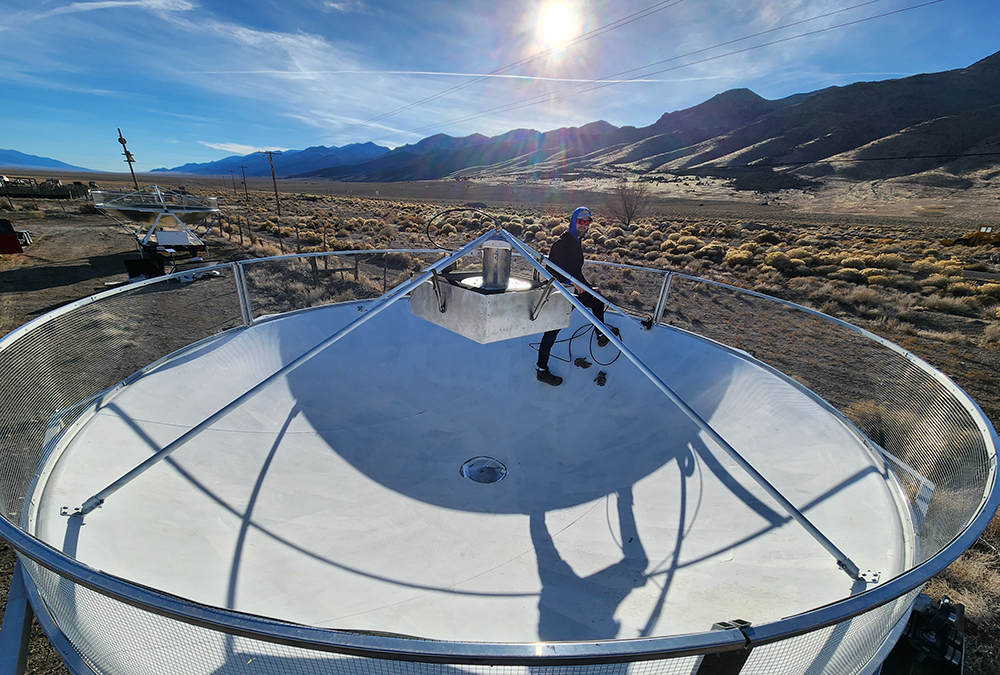 Chalmers, with its flexible studies, research experiences and an ever expanding network opened major opportunities for Jonas Flygare.
 -
-
Long before light reaches our eyes, the universe is telling its story through millions of radio waves that travel in space. They carry clues to some of the greatest mysteries which only the right instruments can capture.
One of the engineers helping build these instruments is Jonas Flygare, a 38-year-old Chalmers alumnus from Mölndal, near Gothenburg, Sweden. Jonas Flygare and his fiancé, whom he met while studying, live in Bishop, California with their dog. At a recent meeting he discussed what it is like to create a new home in a different country, issues with different time zones and how Chalmers, with its flexible studies, research experiences and an ever expanding network opened major opportunities for him.
“You don’t have to know exactly what you want to do when you start. The important thing is to stay curious and be willing to change direction when you discover what excites you.”
Now working in California and Nevada, Jonas is developing the next generation of radio telescopes with technology that could uncover billions of previously unknown radio sources. But his journey didn’t begin with astronomy. It began in a classroom at Chalmers University of Technology.
Discovering a new path
Jonas always loved creating and building things, but when he began studying physics at Chalmers, his goal was clear: theoretical physics. “I wanted to become one of those brilliant physicists who discovers a new law of nature,” he says with a laugh. But an internship at a tech start-up in Santa Barbara became a turning point. They developed technology that could make displays flexible and bendable, an experience that gave him a taste for applied engineering, where ideas quickly became real products.
After he returned to Chalmers, Jonas decided to reshape his master’s studies and gradually filled it with courses in electromagnetics, antenna engineering and computational modeling. “It was easy to adjust my studies once I discovered what I really enjoyed,” Jonas says. “That flexibility at Chalmers was incredibly valuable.”
A temporary job at Sweden’s national facility for radio astronomy hosted by Chalmers, changed everything. It turned into a doctoral project, focusing on designing antennas for SKAO (Square Kilometre Array Observatory).
“In theoretical physics, you might spend years developing an idea that never becomes something you can actually build,” Jonas says. “In antenna engineering, you design it, build it and then you test it yourself. That’s what I love!” -
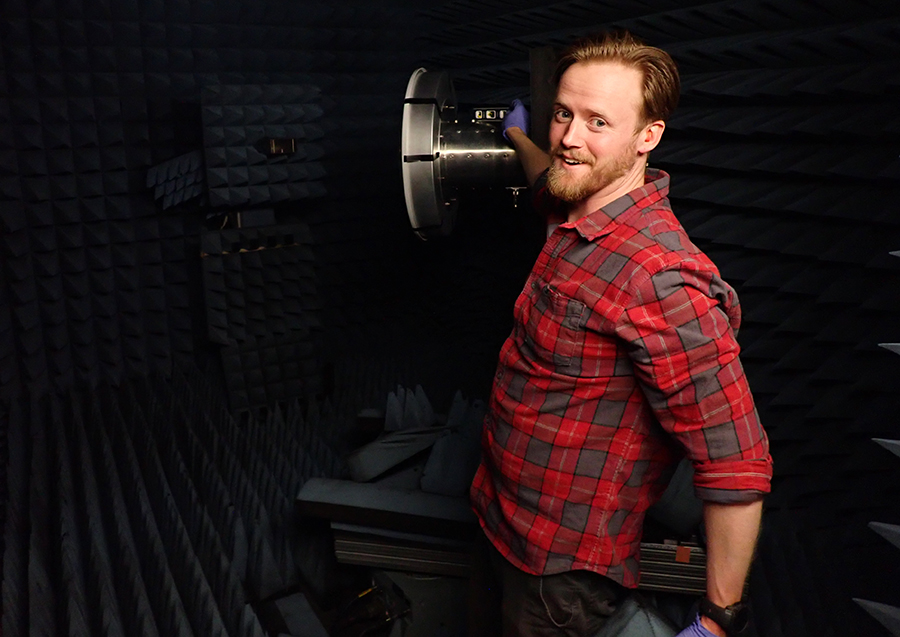 "You don’t have to know exactly what you want to do when you start. The important thing is to stay curious and be willing to change direction when you discover what excites you," Jonas Flygare says.
 -
-
Building the future’s telescopes
During his doctoral research, Jonas had travelled to Canada to test an antenna he had designed. It became a defining moment to see his own product mounted on a prototype telescope, which was later used for scientific observations that resulted in a published research paper.
“You don’t necessarily think, when you’re designing something at your desk, that it will end up on the other side of the world doing real science,” he says. “That gave me confidence that I could take on even bigger challenges.”
Today, Jonas works at the California Institute of Technology (Caltech), where he develops advanced antenna systems for the DSA (Deep Synoptic Array), a radio telescope that will become a game changer for radio astronomy. His job is to design a very critical component: the feed antenna that captures signals from space and delivers them to the telescope’s receivers, with as little signal loss as possible. The goal is to gather as much of each signal as possible and minimize the noise. The cleaner the signal, the more the telescope can detect.
“My job is to build the instrument. Then, the astronomers get to tell me what they’ve discovered with it, which is very exciting.” Traditional radio telescopes study one small area of the sky at a time, but DSA is designed to quickly scan larger areas of the sky. Using thousands of highly sensitive antennas, DSA is expected to detect around one billion previously unknown radio sources within its first five years of operation. Jonas says the telescope could double the total number of known radio sources within its first 24 hours of use. These discoveries could help astronomers better understand black holes, the life cycles of stars and many other mysteries of the universe.
Louise Nyberg -
 Jonas Flygare and his fiancé, whom he met while studying, live in Bishop, California with their dog. At a recent meeting he discussed what it is like to create a new home in a different country, issues with different time zones and how Chalmers, with its flexible studies, research experiences and an ever expanding network opened major opportunities for him.
 -
For more information, see the Chalmers website: www.chalmers.se/masters and www.chalmers.se/scholarships
-
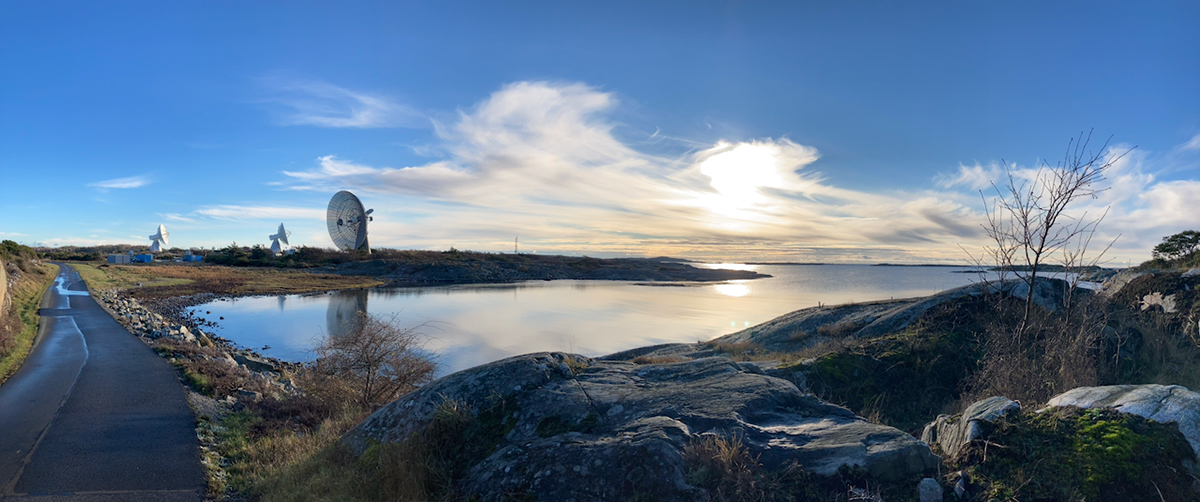 Onsala Space Observatory develops advanced instrumentation and operates world-class radio telescopes.
 -
Sources: Jonas Flygare
https://www.chalmers.se/en/infrastructure/oso/ - Hosted by Chalmers University of Technology, Onsala Space Observatory develops advanced instrumentation and operates world-class radio telescopes. OSO also participates in international collaborations, providing students and researchers with great opportunities. -
-